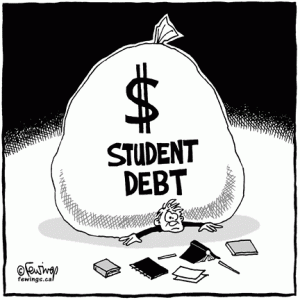
I taught a research-writing class last year called "College!" where students took on research subjects related to higher education. My focus was on the privatization of public education, and among the readings we discussed was Tad Friend's "Protest Studies," about the Berkeley student unrest following major budget cuts in California. I was frankly disheartened, though, by the large number of students who were not asking if we as a society should invest more in public education but instead asking the question, "Is College worth it?" Of course, they meant "is it worth the investment" for the individual, in strictly economic terms. And, from an individual perspective, it might feel like a reasonable question, especially considering that most of them have already gone into debt and have to consider accrued interest in paying back their loans, the high cost of tuition, and the four years of lost wages in making the calculation.
Those who asked "Is College worth it?" did not recognize, however, that the question itself arises out of the privatization of higher education: students now look at the degree purely as an economic benefit to the private individual, something that adds to the graduate's earning power -- on average "about $1 million in a lifetime" (which has been the claim since the Reagan years and confirmed recently, including in The New York Times following Pew Research and by more recent studies; of course, it depends on your degree; and you do have to wait well over a decade after graduation before you catch up with the earnings of your peers who became UPS drivers right out of high school.)
Is college worth it? According to NPR, this question gets asked every time there is a recession and individuals become debt averse. But even from an individual perspective, almost all of us with college degrees can easily answer, "yes." As the author of "Yes, College Is Worth It" (from Confessions of a Community College Dean) relates, few individual graduates would ever surrender their college degrees (and everything associated with that degree), so the easy answer is "Of course college is worth it." And as the Lumina Foundation, the Obama administration, and the Gates Foundation will tell you at great length, it is imperative for our society to get more people to choose college and to graduate. It is not about the individual alone, and it has to be a social commitment to make it happen.
So who is encouraging young people to think that skipping college might be a better option? Who wants us to be asking, "Is college worth it?" Who doesn't want kids going to college? And who is supporting talk of a "college bubble"? (talk recently debunked quite forcefully in an article titled "What bubble?")
Or is it just that we find it so difficult to think outside of the language of privatization, that the question just comes to us naturally? We as a society are now unwilling to help foot the bill, so the cost of college falls to the individual student -- or, as in the cartoon above, it falls on the individual student as his or her private debt. Privatization at its best.
Is college worth it? That's not the right question. A better question is: Can we, as a nation, afford not to send our high school graduates to college?
I attended the New Jersey Writing Alliance's Conference this Tuesday entitled "Writing for the 21st Century: Expectations, Experience and Exigencies" (http://www2.bergen.edu/njwa/index.asp). As I walked through the halls at the College Center building of the Middlesex County College Edison Campus, I thought heavily about the word exigency. The needs of our students at the college level are compounded by lives filled with mutlimodal media, the stress for job-specific academic careers and difficult financial times. The budgetary issues facing New Jersey school districts and public universities have made instruction an even larger challenge. The board members of the NJWA desired to address these issues and many more as they related to the transition from high school to college writing.
My desire to see what high school teachers felt about college writing sent me to many sessions involving the transition between the two and how to deliver effective remedial instruction. My first session was a themed panel involving two presentations. This theme was called "Helping Students Transition to College and the Real World." Dr. Kathy Mueller presented a documentary she developed about students' transition from her class to college writing. Her anecdotal work presented a gap between high school writing and what students are asked to do in college. She highlighted several areas involving argumentation and the need for textual support when students make claims. Dr. Mueller has worked closely with my colleagues, Mr. Michael Goeller and Ms. Regina Masiello. They have conducted professional development seminars in her district, Bayville Public School District, involving the work we do at the Writing Program and the Writing Program Institute. Her presentation called for more focus on close reading, peer revision, and strategies to answer complex writing assignments. Dr. Linda Littman and Ms. Jane DeTullio focused on in-classroom activities and discussion-based practices as an example of a way to bridge the gap. Many teachers responded later to this panel as desiring that writing instruction be presented as uninterrupted rather than a gap with two ends needing to be bridged. A call for a community of instructors in writing was received loud and clear. The teachers seemed to desire a community with regular conversations about how we all address the need for more complex thinking and writing.
The next session I attended discussed the Second Language Learner (L2) and what he or she can teach us about how to help him or her. Dr. Darcy Gioia, a director in the Writing Program, and Ms. Agnieszka Goeller, a fellow Writing Program instructor, used personal anecdotes and theoretical concepts based on their experience to help the audience understand the L2 learner. They expanded upon trends they noticed in the learning patterns of the L2 learner. They postulated on how an instructor might be able to ask questions that approach the core of the pattern of language issues plaguing the L2 learner. Individualized instruction is something every teacher can understand pedagogically. We all develop individualized instructional plans for our students, and the L2 learner is no exception. Dr. Gioia echoed an equal focus on argument in her instruction that Dr. Mueller mentioned in the first panel. Dr. Gioia sees her remedial instruction as in direct support of the standards upheld by the Writing Program. When she spoke of patterns of error in her panel, one teacher in the audience emphatically nodded in agreement. This expression reminded me that fundamentally all teachers of writing feel a commonality. We all want to improve our students' abilities and understand the need for claims of their own to exist in their writing. The remedial instruction performed at the Writing Program is one way to envision the writing process as a continuum across a student's entire academic career instead of within one semester or course.
The final session I attended was a round table discussion about the topics of the conference's subtitle. High school and college instructors investigated the new needs of students brought about by non-fiction focused standardized testing, including the HSPA and SAT. Many instructors identified a need for critical thinking and exposition as a necessity in their college classrooms. Although there was a brief hint of animosity between the two seemingly opposing entities within teaching, a sigh of relief came when one administrator expressed her vision of a continuum on which all writing instruction was placed. Instead of questions like what is the difference between the high school and college writing classroom? Ones arose asking, how do teachers achieve the same standards in different modes of instruction? What do the college instructors do in the classroom that the high school teachers can learn from? What can high school instructors teach their students about the college arena? How can college instructors adopt the instruction currently given in high school? And finally, what should we do with the "5-paragraph essay?"
Although the "5-paragraph essay" is seen as a problematic issue for critical thinking and writing because of its formulaic presentation, many college-level professionals said that it in fact presented a moment in a student's learning process that was a necessity to build critical thinking, a requirement at the collegiate level. Arising out of this structure presented the idea that a student's writing is a process throughout his or her academic career. Although many of us at the collegiate level recognize writing as a revision process, we might fail to see it as a developmental one. A developmental continuum that includes structural moments like the "5-paragraph essay," literary interjections like The Adventures of Huckleberry Finn, and connectivity between authors as we teach in Expository Writing can address the problem modern teachers face in the classroom. We desire our students to be involved in a larger academic discourse and in doing so must change our vision for writing based on the very questions brought up at the conference.
The WPI attempts to administer these very values to high school teachers in an attempt to collaborate with school districts. I believe that my attendance at the conference identified for me a serious problem of vision for writing instruction and recognition that many professionals across New Jersey are aptly ready to take these issues to task. Missions like the WPI are the very theoretical basis we need to help continue this conversation towards a learning initiative. The idea that student learning is an uninterrupted path can help to underscore the collaborative nature of this conversation.
Professor Dorothy Strickland of Rutgers University last week made a PowerPoint presentation to the New Jersey Board of Education on The Common Core State Standards Initiative (CCSS), which might mark the beginning of a wider discussion how these standards will change the curriculum. We think it's important that those in education looking to improve college readiness get involved in the process, especially before major corporations begin selling their solutions. Ultimately, the spirit of the Common Core can only be honored if we find a way of communicating its standards to teachers so that they can put them into practice themselves rather than purchasing some "one size fits all" solution.
As a slide in Professor Strickland's presentation cautions, it's important to "Establish a long-term program of information, communication, and active collaboration with all stakeholders" before buying into the "mass delivery of standardized instruction." After all: "Knowledge and understanding of the Standards and the new Assessment Programs will be critical for good consumerism."
The Rutgers Writing Program is definitely a stakeholder in seeing that students are honestly made ready for college success. We hope that the Common Core does not go the way of No Child Left Behind and become just another test-focused program. As you move from recommending pedagogy to developing assessments, though, there is always the danger that standards will get boiled down into bubbles that #2 pencils can fill and a large corporation can sell. And then the teachers become simply the means of delivering content.
Some of the news coverage of the Common Core suggests that we should be cautious about it being hijacked by the education-industrial complex. Though the CCSS initiative began about two years ago and its standards, released last year, have been adopted by 44 states, it seems it only began to make the news when corporations began showing interest, as when the Gates Foundation announced that it will partner with Pearson Publishing to develop Common Core materials for classroom use, or when other potential content providers sent out press releases about their plans (such as: "LitLife to Assist Schools with Common Core Compliance").
Assistant State Superintendent Robert Hull says changes to [English and language arts] will primarily involve the use of more 21st century
literature and nonfiction, rather than just fiction. Educators also want
a better focus on the writing process.
The amount of informational texts (nonfiction) compared to literary
(fiction) found in classrooms is not known, but Edwina Howard-Jack,
English/language arts coordinator for the state office of instruction,
says the new standards place much more emphasis on informational texts.
Even in kindergarten, the new English/language arts standards call for
half of the texts to be informational and the other half literary. By
senior year, that would become 70 percent informational and 30 percent
literary.
Another change will be reflected in increasing the difficulty in the
required texts. Howard-Jack says there is generally a two-grade
difference in the level of difficulty of most required texts currently
offered.
'In working with teachers within the West Virginia framework, the
teachers are just thrilled with these new standards and objectives. This
is the direction we need to go and will make a difference in public and
higher education,' Howard-Jack said.
Tightening the standards to become more focused on factual texts is also
reflected in changes to writing expectations. Less emphasis will be
placed on narrative and more on argumentative and explanatory writing.
The Rutgers Writing Program has long advocated the use of non-fiction prose about complex ideas and the need to emphasize the reading and writing of expository (rather than narrative) prose in high school. The only way to engage students with this literature and the ideas it contains is to get them writing on their own, applying those ideas in novel ways, and making connections across multiple complex texts. It's not something you can boil down to filling in bubbles with a number two pencil. And it requires knowledgeable and engaged teachers to administer. We hope everyone keeps that in mind.
To confront the typically unspoken truth about why students throughout this country have so little practice writing formal essays, read Kim Brooks's "Death to High School English" in Salon.com. Though she approaches the problem, rather divisively, from the perspective of a college professor complaining about the lack of writing instruction her students received in high school, Brooks ultimately highlights the common issues that we all confront as teachers of writing and the common burden we share, whether we teach in secondary schools or colleges. Most importantly, Brooks visits a high school and confronts what is to my mind the core "logistical issue" of why students don't write more, which boils down to:
...the almost insurmountable challenge of teacher-to-student ratios, miserable ratios that are only going to get more miserable in light of the devastating teacher layoffs taking place around the country. At this particular school, every English teacher teaches five sections of English, and each section has approximately 25 students -- a dream load compared to what teachers at, say, a Chicago public face. But that still means a three-page formal essay assignment would translate into 375 pages of student prose to be read, critiqued and evaluated. The very thought makes a cold, dark dread creep across my soul. It makes my own burden, two sections of composition, 15 students to a class, seem laughably light. And yet, to my more successful, tenured friends, even my numbers seem grueling. One of them says flatly, "I'd teach four sections of lit before I'd do one of comp. Four sections with my hands tied behind my back. It's just too much work."
As Brooks points out, the labor issue does not go away in college either: most of us who teach college English would prefer not to assign a lot of writing either, or to grade it with the care of a composition instructor. Many literature professors get to teach with "their hands tied behind their backs" for most of the term, with the final papers in their classes used only for grading purposes.
The labor of grading is the 500-pound gorilla in the room in any discussion of how we improve student writing.
In my own visits to high schools, I have frequently heard about this "logistical issue" that prevents teachers from assigning many formal essays in their classes: to do so would mean an unbearable burden and an additional month of uncompensated labor. Who would willingly subject themselves to that if they did not have to? -- especially when most of their colleagues don't do it and there will be no rewards for doing so. In fact, assigning essays and grading them accurately will mean unhappy students and parents, talks with administrators, and little support from colleagues -- not to mention all of that work of commenting and grading.
If we are honestly to confront how we get students to do more writing, we have to begin by confronting this problem and to do so at a structural level. And I admire all of the great schools I've visited where administrators are the ones leading the way toward change, because it is they who are best positioned to deal with this "logistical issue" head on.
Unfortunately, given the funding realities that public schools face, I don't have any easy answers for how they should do that. Not yet anyway. But I think it helps to raise the question and to do so honestly. It will make us begin looking for an answer.
For more information about the Writing Program Institute Summer College for Teachers, visit our website, which offers complete details and links to registration information. Teachers completing the course receive 16 hours of professional development credit.
Regina Masiello and Michael Goeller present to teachers.
Teachers from a range of disciplines were in attendance.
We thought the sign was so nice we had to get a picture.
Afterwards, Michael had to get a picture with the school mascot.
Regina Masiello and Michael Goeller gave the first in a series of presentations at the Central Regional High School in Bayville, New Jersey, to a group of about 15 teachers plus administrators. We talked about the growing importance of non-fiction prose and how teachers can incorporate it into the high school curriculum.
While the majority of teachers were from English and language arts, there were also Spanish, Math, and Science teachers present. One of the administrators brought up the importance of teaching students to read carefully in order to help them understand science texts or grasp "word problems" in math. I recently attended a wonderful talk by Jane E. Miller of the Edward J. Bloustein School at Rutgers University, author of The Chicago Guide to Writing about Numbers, which brought home the point that if we do not address this issue in high school then we are dealing with a remedial writing problem when students get to college. Prof. Miller has some excellent resources at her website (under the heading "Writing about Numbers"), and I was especially impressed by her article on "How to Communicate Statistical Findings," which includes specific expository writing advice that would benefit high school students.